
I published a full data breakdown of Ukraine's restaurant market last week: record revenue, falling foot traffic, a delivery market that keeps adding competitors instead of consolidating. Every number in it is real and sourced. But sitting with it for a few more days, I've landed on something the data alone doesn't say out loud — I think the market is bigger and more durable than almost anyone outside the country currently believes.
The revenue jump is mostly the market becoming visible
₴246.7bn in declared 2025 revenue looks like explosive growth next to a few years ago. Most of that gap isn't new spending; it's spending that was already happening in cash, off the books, before mandatory fiscal registers forced it into daylight. If a hidden restaurant economy that large existed under wartime conditions, the real size of the market has probably been understated for years. Formalization doesn't create demand — it stops hiding it.
Operators are voting with square footage
McDonald's opened new locations in 2025. KFC's franchisees grew revenue 32% in a single year. Aroma Kava keeps adding cafés. These are companies with far more cost-of-capital discipline than anyone writing headlines about the market, and they're choosing to expand inside a country at war. That's not sentiment. It's underwriting, and the people closest to the P&L usually know more than the people writing about it from outside.
A market this fast at killing weak concepts is maturing, not dying
Half the venues that closed in 2025 didn't make it 18 months. In a stable Western market, that kind of turnover takes a decade of retail Darwinism to play out. Ukraine is compressing that cycle into a couple of years, because the war removed slack from every part of the economy at once. It's brutal for the operators who don't make it, but it's the same mechanism that produces a market dominated by strong, digital-native brands faster than peacetime competition ever would.
Four platforms don't fight over a shrinking pie
Four real companies are competing for the same delivery orders right now, not two and not a monopoly, including a retail giant building on top of an existing 1.5 million user base. A market limping along doesn't attract that kind of competition. A market with enough transaction volume and margin to be worth fighting for does.
None of this means the war's effect on demand is fake, or that regional variation doesn't matter. Traffic is down double digits in some cities, and the operating environment is genuinely harder than it was before 2022. But "harder" and "smaller than people think" are different claims, and most outside coverage collapses them into one. I don't think they're the same thing. Ukraine's restaurant market looks, to me, bigger, more resilient, and further along than the headlines, including some of my own numbers, make it look.
If you're building for this market, or deciding whether to, that gap between perception and reality is exactly where the opportunity sits.
More insights
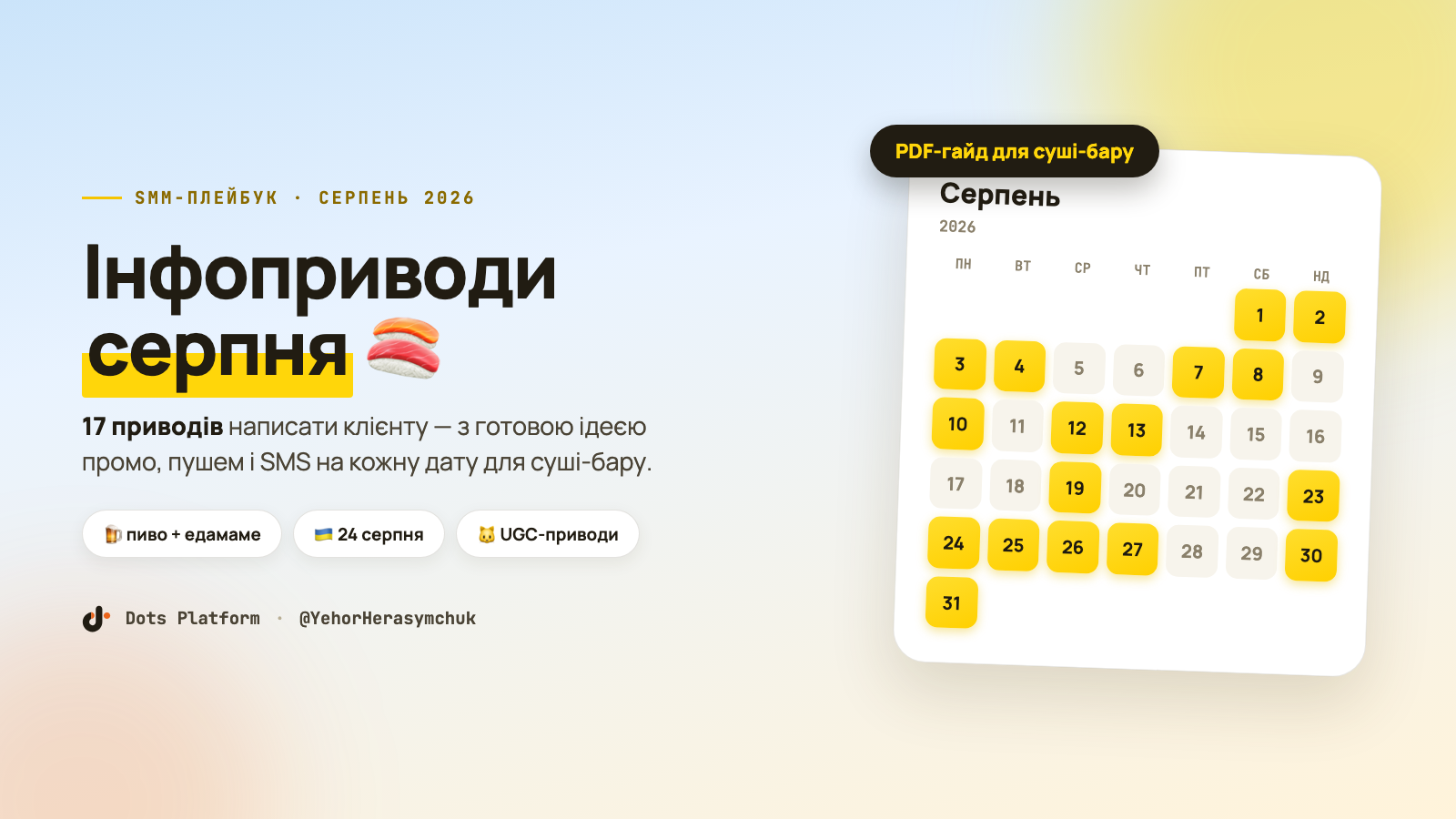
August content calendar for sushi bars: 17 occasions with ready push and SMS copy
A ready August content plan for sushi bars: 17 dates, a promo mechanic for each, plus push and SMS copy. Downl...
28 julio 2026
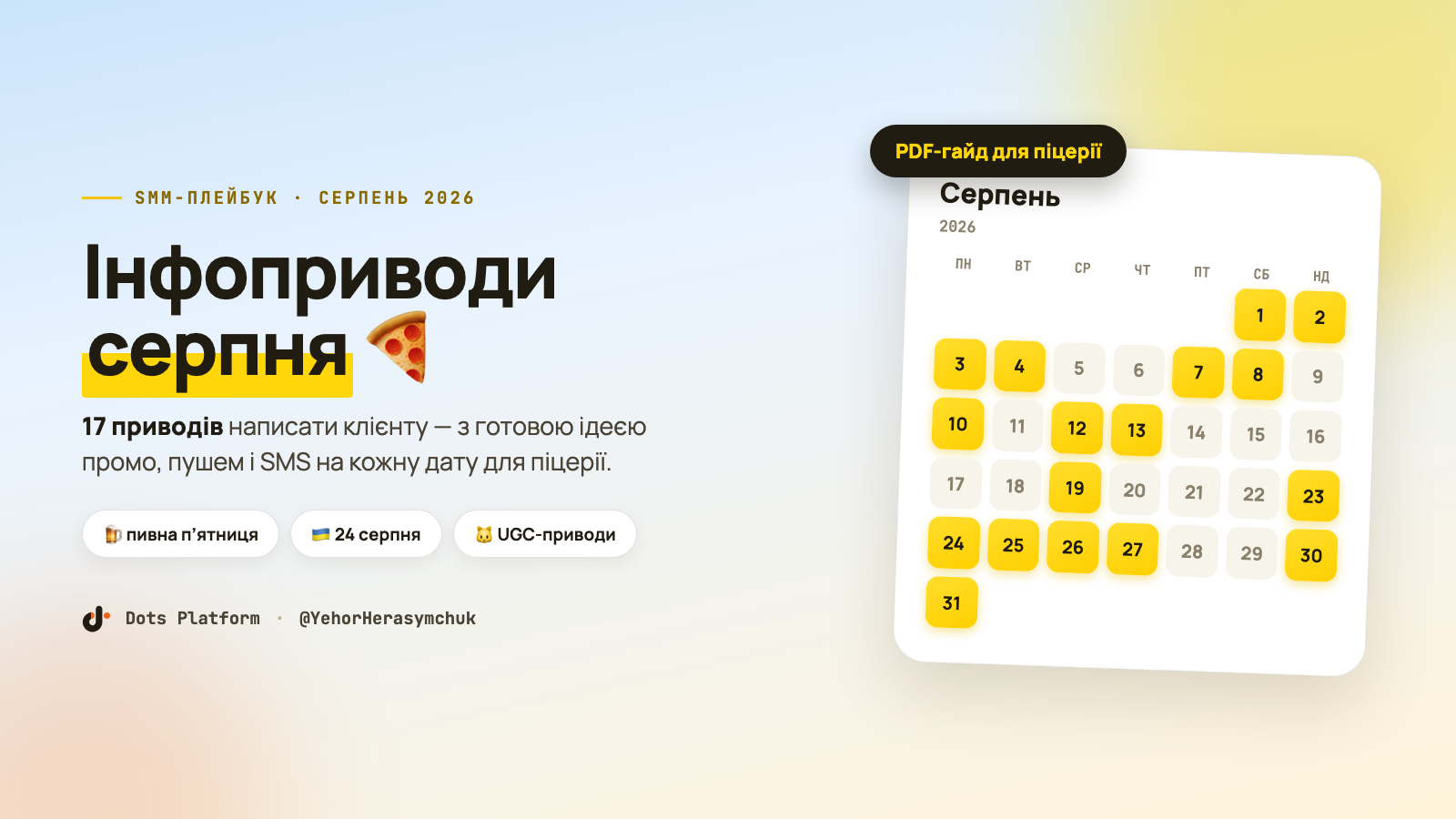
August content calendar for pizzerias: 17 occasions with ready push and SMS copy
A ready August content plan for pizzerias: 17 dates, a promo mechanic for each, plus push and SMS copy. Downlo...
28 julio 2026
Why marketplaces quietly eat your margin
The real economics of working with Glovo, Bolt and Wolt — and what the “free” connection actually costs you.
02 junio 2026
Tell me about your restaurant.
No pitch, no jargon. I’ll look at your numbers honestly and tell you whether your own delivery makes sense for you — and if it doesn’t, I’ll say so. Just two people who care about food and about building something that lasts.

I’m always open to talk about how to grow together — whether you’re a new partner or already work with me. In fact, I talk even more with existing partners, and I never leave them on their own.